Why Lumberton? Honoring Community, Resilience, and 10 Years of Showing Up
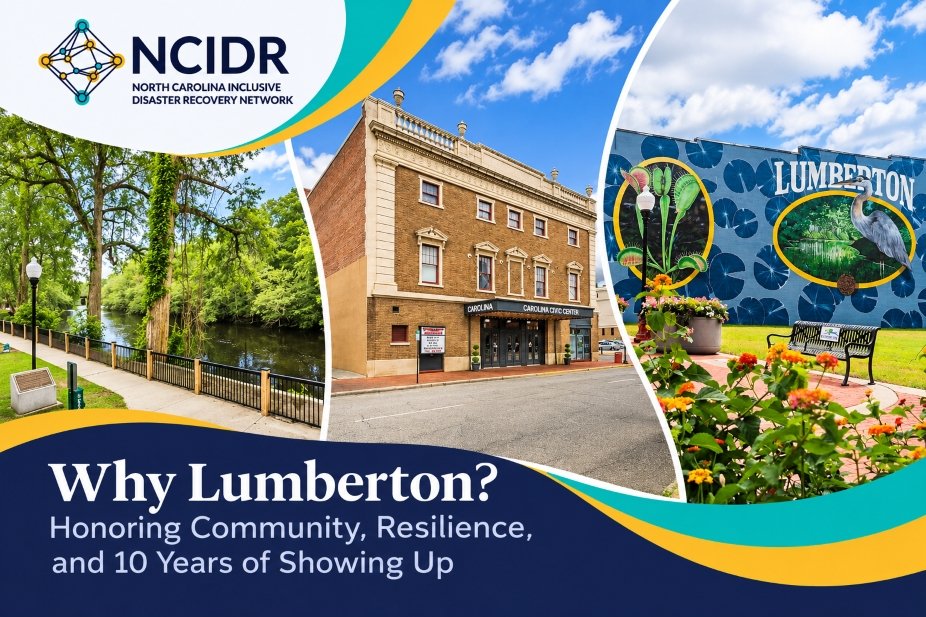
As NCIDR prepares to mark its 10th anniversary in southeastern North Carolina, community leaders reflect on the relationships that have sustained recovery, and the work still ahead.
When the North Carolina Inclusive Disaster Recovery Network (NCIDR) gathers in Lumberton this November to mark its 10th anniversary, the location will be more than a backdrop for the occasion.
It will be part of the story.
Ten years ago, Hurricane Matthew brought devastating flooding to Robeson County and communities across southeastern North Carolina. Less than two years later, Hurricane Florence brought another round of destruction, testing communities that were still recovering.
But amid those challenges, something else became clear: the extraordinary ways neighbors, local businesses, faith communities, and organizations came together to help one another.
For Brianna Goodwin, executive director of the Robeson County Church and Community Center (RCCCC), those relationships remain one of the most important lessons from that time.
During a recent conversation with NCIDR, Goodwin recalled how people from different neighborhoods, backgrounds, and walks of life worked together to meet urgent needs.
She remembered local businesses sharing whatever resources they could, including a gas station owner who helped ensure that first responders and community members had access to fuel when electronic payment systems were unavailable.
These acts of generosity were not simply moments of kindness. They reflected the community knowledge, relationships, and willingness to help that would become essential to recovery.
Recovery doesn’t end when the storm passes
In neighboring Columbus County, Curtis Hill has seen firsthand how those relationships matter long after the immediate emergency ends.
Hill, a disaster and outreach supervising advocate with Disability Rights North Carolina who also works with the Columbus County Forum and local long-term recovery efforts, described how recovery depends on relationships that can be called upon again and again.
Some partnerships emerge during a disaster. Others have been built over years of working together. Both matter, but sustaining them requires time, resources, and commitment.
For communities across Robeson, Columbus, Bladen, and other southeastern counties, the challenges of recovery are not confined to the weeks or months after a storm.
Housing needs, financial barriers, access to assistance, and the capacity of local organizations to continue serving residents can persist for years.
Goodwin described the importance of continuing to listen to residents and respond to their needs even when the work is no longer labeled disaster recovery.
At RCCCC, that includes maintaining community relationships, gathering feedback, and involving local residents in shaping the organization’s work.
Her perspective underscores a lesson that runs throughout NCIDR’s history: trust is built through consistent presence, not just emergency response.
Why this place matters
For Goodwin, hosting the anniversary in Lumberton is also an opportunity to share a fuller picture of Robeson County.
She spoke warmly about the region’s landscape, farmland, rivers, and natural beauty, as well as the diversity of its communities.
Robeson County is home to people with different cultural, racial, and socioeconomic backgrounds, whose experiences and perspectives all contribute to the region’s identity.
That diversity is part of what makes the area an important place to explore collaboration.
Goodwin hopes visitors will see the community’s strengths and possibilities alongside the challenges that remain.
Ten years after Matthew, some residents are still navigating the consequences of repeated disasters. At the same time, local organizations and community leaders have continued finding ways to respond, advocate, and build toward the future.
Both realities deserve recognition.
Patrick Woodie, president and CEO of the North Carolina Rural Center, also emphasized the importance of gathering in southeastern North Carolina. Reflecting on the response to Matthew, he recalled how organizations came together to coordinate assistance and how the relationships formed during that period continued to have value in subsequent years.
For Woodie, the region offers an important example of the role local organizations and trusted community relationships play in recovery.
Connecting communities across North Carolina
The anniversary gathering also reflects a larger purpose.
NCIDR was formed in 2016 following Hurricane Matthew to strengthen collaboration among organizations working on disaster recovery and to support community voices in the decisions affecting their lives.
Since then, the network has connected partners across North Carolina through hurricanes, the COVID-19 pandemic, and other emergencies.
Andrew Shoenig, MDC’s program director for community resilience and NCIDR facilitator, described how lessons from eastern North Carolina have helped inform the network’s approach to more recent disasters, including Helene in western North Carolina.
The challenges may look different from one community to another, but the importance of coordination, trusted relationships, and community leadership remains constant.
The November 9–10 gathering will bring these experiences together.
Hosted in partnership with RCCCC at the Carolina Civic Center, the anniversary will feature artistic performances, storytelling, discussions of long-term recovery, and opportunities for network members to develop a shared vision for the next decade.
It will also be the network’s first in-person gathering since the COVID-19 pandemic.
Looking ahead, together
There is a lot to recognize after 10 years of NCIDR: the relationships formed, the knowledge shared, the advocacy undertaken, and the community leaders who have continued showing up.
There is also much more to do.
For communities in southeastern North Carolina, recovery from past disasters remains part of everyday life. And across the state, the experience of Helene has reinforced the need for stronger systems, sustained resources, and connections that reach across geographic and organizational boundaries.
Gathering in Lumberton creates space to honor both the persistence of these challenges and the leadership of the people working to address them.
It is a chance to listen, reconnect, learn from one another, and imagine what more inclusive disaster recovery could look like in 2036.
And perhaps most importantly, it reminds us that the relationships communities rely on in moments of crisis are built and sustained by showing up for one another, year after year.
Learn more about NCIDR’s 10th Anniversary Convening, November 9–10 in Lumberton.


