H.R. 1’s Impacts on the South: 2026 Update
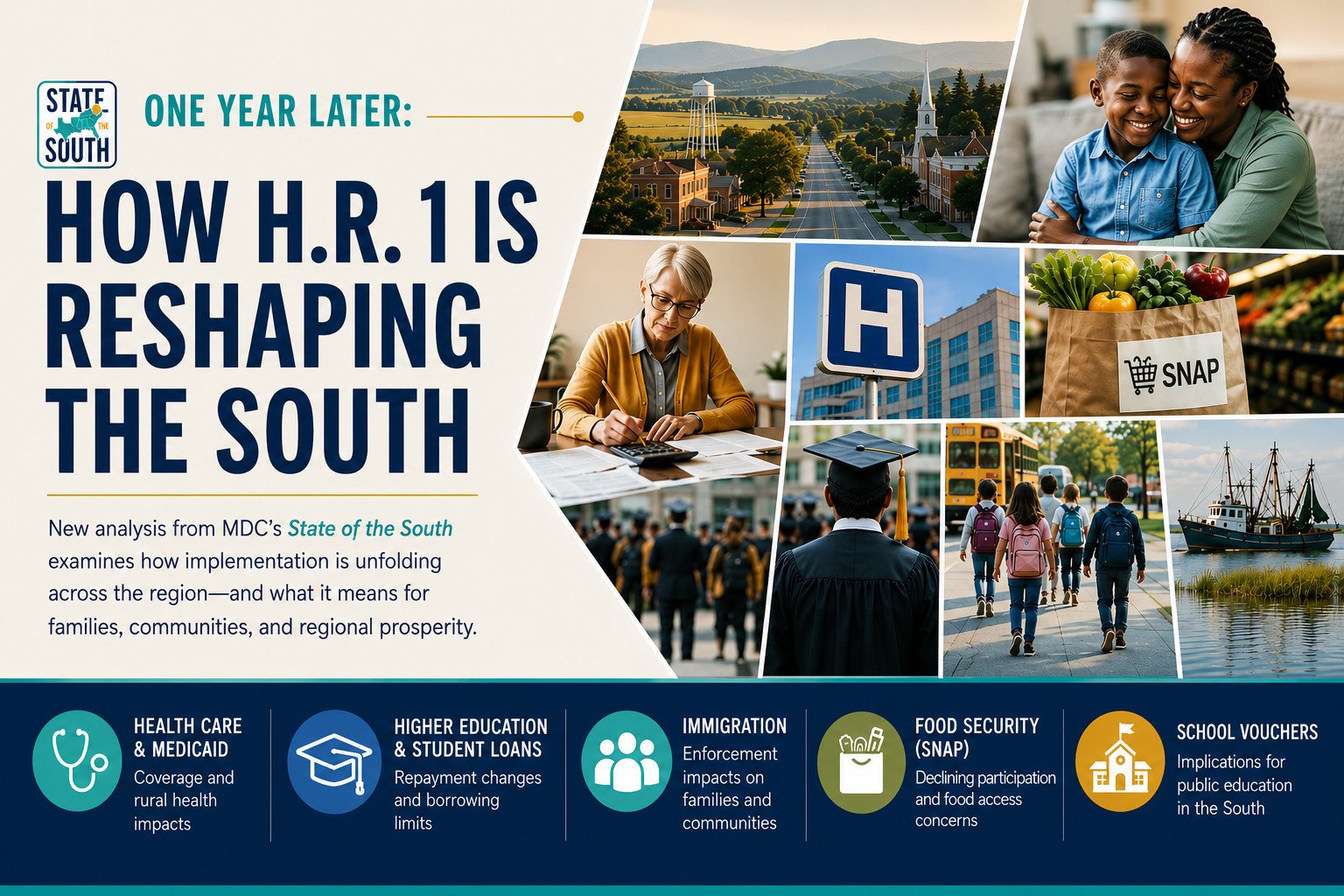
On July 4, 2025, H.R. 1 was signed into law, a federal budget reconciliation bill misleadingly named the “One Big Beautiful Bill Act.” The sweeping changes included in the bill represent a dire threat to Southern economic security, public health, education, and the social fabric of our region. One year later, MDC is sharing an updated look at implications for the South as implementation gets underway in the 13 Southern states.
Medicaid
States have just six months left to implement the significant changes that H.R. 1 makes to Medicaid coverage before the legislation’s start date of January 1, 2027. There are several major changes that providers are scrambling to apply before the deadline, and the new rules will both cause millions of Southerners to lose coverage and be extremely expensive for states.
The eligibility redetermination period for Affordable Care Act Medicaid expansion enrollees will drop from once per year to once every six months. With the six-month redetermination period, it is estimated that about 77% of Medicaid expansion enrollees will keep coverage in 2028, while 13% will be ineligible due to higher earnings in that month and 11% will be procedurally disenrolled. Average monthly Medicaid expansion enrollment will likely drop by 3.1 million (17%) in 2028 as a result of the increased frequency of redeterminations.
Work requirements will likely cause somewhere between 3 and 7 million additional Medicaid expansion enrollees to lose coverage. The final numbers will depend on the extent of provisions made during the implementation process to minimize the number of coverage losses. Collectively, among the six Southern states that have expanded Medicaid, anywhere from 646,000 to 1,299,000 Southerners will likely lose coverage due to the H.R. 1 work requirements and increased redeterminations policy in 2028. The work requirements will force adults in the Medicaid expansion population to document at least $580 in income per month, complete at least 80 hours per month of work or volunteer service, or qualify for an exemption to continue coverage.
States have been working rapidly since H.R. 1 passed to prepare their systems for the added verifications and requirements, but the needed changes and technological upgrades are extensive and costly. New guidance issued by the federal government on June 1, 2026 adds new unexpected complexities to the definition of “medically frail,” reducing the number of people who will qualify for the exemption while adding paperwork and reducing automation. The new guidance means states will have to redo significant amounts of preparation on the already-tight timeline for H.R. 1’s January 1st deadline. It’s unlikely that states will be fully prepared to implement all the new requirements and restrictions on January 1, as systems are still being built, data sets are still being constructed, and employees are still being trained on all the updated changes and processes. The rushed timeline for implementation increases the likelihood of erroneous coverage losses due to the added administrative burdens, and no Southerner should be forced to forgo critical medical care due to unnecessary paperwork and administrative errors.
Acknowledging the changes and cuts to Medicaid will be deeply felt in rural communities, H.R. 1 established the Rural Health Transformation Program to offset some of the costs to rural communities. The $50 billion earmarked for the program does not come close to covering the true cost of these cuts to rural areas (estimated at $137 billion), and the program uses cooperative agreements instead of grants to tightly control how states are allowed to spend the Rural Health Transformation Program funds. Several states, including Tennessee, have had to change their policies and plans due to the threat of federal “clawbacks” of money that has already been awarded. This is a nationwide issue: officials in Maine scrapped plans to use funds to treat low-income, uninsured patients; Vermont pulled a plan to increase housing for rural healthcare workers; and Wyoming was unable to invest its award to generate a new source of funding due to federal feedback. By tightly controlling the eligibility for and use of funds, the federal government further limits states’ ability to spend this money where it is most needed and instead creates more red tape for states already struggling to implement the new restrictions from H.R. 1 on an extremely short timeline.
Student Loans
H.R. 1 dramatically changed the landscape for student loan borrowers and for Southerners considering pursuing graduate or professional degrees. Starting July 1, 2026, new borrowers will only have access to two repayment plans: the Tiered Standard Plan, in which the loan amount determines the repayment period and payment size, and the new Repayment Assistance Plan (RAP), in which payment size is determined by income for a repayment period of 30 years – but all borrowers must pay at least $10 per month toward repayment, regardless of income or financial hardships. Unlike previous income-based repayment plans, which calculated payments based on borrowers’ discretionary income and only required payments once borrowers’ incomes are a certain amount above the federal poverty line, the RAP calculates payments based on borrowers’ gross income, requiring payments from even those earning below the federal poverty level and forcing some into a choice between repaying student loans or paying for necessities like rent, groceries, or medical care. Additionally, the RAP bases payments on arbitrary income tiers, and small cost-of-living increases for borrowers could result in a disproportionately high spike in student loan payments, as illustrated below. The new RAP and limiting repayment plan options will disproportionately harm low-income borrowers, and Southerners may end up facing choices between career advancement and higher wages or keeping an affordable monthly student loan payment – limiting opportunities for economic mobility and choice for borrowers.

Credit: The Institute for College Access and Success. The SAVE Plan replaced the REPAYE plan, and the SAVE Plan has now been officially ended by the court system.
Graduate and professional students will soon face much tighter restrictions on their borrowing abilities. Graduate students are now limited to borrowing $20,500 per year, and up to $100,000 total – a big change from the previous rules, where students could borrow up to the total cost of their programs (which often exceed the new borrowing limits). Exempt from this rule are students of “professional” programs, who are restricted to $50,000 per year and $200,000 total in federal loans. In April 2026, the Department of Education published its final rule, which further limits the programs eligible for the higher loan amounts to just 11 disciplines: chiropractic, clinical psychology, dentistry, law, medicine, optometry, osteopathic medicine, pharmacy, podiatry, theology and veterinary medicine. Among the many disciplines absent from this list are nursing, physical therapy, education, and social work, leading to concerns from organizations such as the American Nurses Association, the American Academy of Physician Associates, and the National Educators Association that the new borrowing rules will exacerbate existing education and medical professional shortages, particularly in rural communities. A lawsuit has been filed by 24 states and the District of Columbia in response to this provision of the final rule. (As of June 29, 2026, a federal judge has paused the implementation of the initial rule and temporarily allowed a broader definition of professional degrees, including nursing and physician associates, while certain theology, psychology, and pharmaceutical degrees are currently considered non-professional. Litigation is ongoing.) For context, the average doctoral degree costs $98,015; the average master of education costs $44,640, while program costs for master’s degrees in business, arts, social work, and public administration range between $60,000 and $80,000. Law school graduates in the class of 2026 paid an average of $198,788, while medical school graduates in the class of 2025 paid an average of $228,959.
Research from the Consumer Finance Institute at the Federal Reserve Bank of Philadelphia indicates that of federal student loan borrowers entering graduate school between 2015-2024, 27% of master’s degree students, 36% of professional students, and 46% of doctoral students borrowed above their new respective loan limits and would likely need to turn to private loans to cover the gap between the federal loan limit and the true cost of the program – but researchers estimate that about 38% of these students may struggle to be approved for loans based on their credit scores. Because of limited access to banking systems, financial literacy training, and the ability to build credit, the new restrictions on federal lending will disproportionately harm communities of color, especially in the South. An estimated 62.2% of residents in majority Black neighborhoods, 61.1% of residents in majority Native American neighborhoods, and 48.1% of residents in majority Hispanic neighborhoods may be denied private student loans based on a lack of credit history or low credit scores.
For parents seeking to take out loans to help their students, Parent PLUS loans will now be subject to a $20,000 cap per dependent each year, with a total limit of $65,000 per dependent. New Parent PLUS borrowers will only have access to the Tiered Standard Plan for loan repayment, with no income-based payment schedule or time or public-service forgiveness allowed. Previously, Parent PLUS borrowers were eligible for loans up to the cost of their student’s program, meaning these families may also need to seek out private loans. Parent PLUS loans have been particularly popular at HBCUs, making the new restrictions in H.R. 1 especially challenging for Black families and communities.
Immigration
One of the most visible impacts of H.R. 1 over the past year has been the sharp increase in immigration enforcement operations throughout the country, supercharged by the $45 billion for detention and $32 billion for immigration agents and enforcement and deportation operations allocated for Immigration and Customs Enforcement through 2029 in H.R. 1. The increased enforcement operations throughout the South caused businesses to shutter, children to miss school, and parents to miss work due to fear of detainment and deportation. Enforcement operations are bad for local economies, leading to a reduction in consumer demand and spending as folks stay home due to fear. A Brookings Institute study of the first six months of increased immigration enforcement in 2025 documented 52,000 excess arrests made by ICE cost about. They estimate that this resulted in 668,000 lost jobs – between 8% and 45% of which are estimated to have been held by American-born workers. Notably, this study focused on the first half of 2025 – before H.R. 1 was passed. Economic impacts today are almost certainly even greater; yet, increased ICE operations continued under the guise of “reducing crime” despite evidence that immigrants are less likely to commit crimes than U.S.-born individuals.

Memphis, Tennessee, has been the target of an ongoing large-scale immigration operation since September 2025 under the “Memphis Safe Task Force” partnership between Republican Governor Bill Lee, the White House, and 287(g) contracts that essentially allow local officers to have similar powers to federal immigration officials in exchange for federal funding. From October 2025-February 2026, the task force has made over 5,200 arrests, only about a quarter of which have been for violent crimes. Of the over 800 immigrants deemed unlawfully present in these arrests, only 17 individuals were also arrested for violent crimes. The most arrests in any part of Memphis have occurred in Parkway Village, a majority Black community and one of the fastest-growing Hispanic neighborhoods in Memphis. Some Tennessee lawmakers are now challenging the governor’s actions in court, and local community organizations such as Vecindarios 901, Memphis Interfaith Coalition for Action and Hope, and Tennessee Immigrant and Refugee Rights Coalition are working to protect residents, document and observe ICE activity, work with local officials to ensure students can get to school safely, and attempt to terminate 287(g) contracts.
The highest concentration of 287(g) contracts is in the South – often in rural communities where less funding for law enforcement is available from city and county governments. 347 local and state agencies have signed these agreements in Florida alone.

Source: The New York Times (emphasis added)
New Orleans, Louisiana, became the target of “Operation Catahoula Crunch” in December 2025. The operation began after at least 23 nearby local agencies entered into a 287(g) agreement with ICE in 2025, and a federal judge ended a 12-year police oversight program in New Orleans. Louisiana is also host to the second-highest number of immigration detention centers, following only Texas. Local leaders in New Orleans pushed back against the ICE presence in the city, even as state officials welcomed the enforcement. Organizations such as Union Migrante and the Louisiana Organization for Refugees and Immigrants organized protests, offered “Know Your Rights” trainings, provided free legal services, and initiated food deliveries to families who were concerned about encountering immigration officers. About 400 people were arrested during the operation, well short of the Department of Homeland Security’s stated goal of 5,000 arrests.
In North Carolina, “Operation Charlotte’s Web” targeted Charlotte and the Research Triangle Park area in November and December 2025. Over 1,100 people were arrested in the weeks before and during the operation, only 30% of whom had previous criminal convictions. The identities and final numbers of those who were arrested in North Carolina are still unknown, as news organizations have been waiting months for their information requests to be filled. During the operation, agents were met with protests, closed businesses, and parent volunteers rallying to protect students as they arrived at and departed from school.
The impacts of increased enforcement are deeply harmful, including for New Orleans, LA resident Guevara Brito and his family, a Venezuelan national who entered the U.S. with humanitarian parole seeking asylum in 2024 who was arrested during this operation after the Trump administration terminated the parole program for Venezuelans in January 2025. 3,800 children have been placed in family detention centers since March 2025, and according to the American Academy of Pediatrics, “there is no evidence indicating that any time in detention is safe for children.” The trauma of family separation can have profound negative mental and physical health impacts on children, leading to depression, anxiety, and post-traumatic stress disorder in the short-term as well as chronic conditions like heart disease, diabetes, and cancer later in their lives.
Local governments throughout the country play an important role in holding federal agents accountable, filing lawsuits and creating legal protections where possible, and sharing information and resources with the public. Community organizers have been holding “know your rights” trainings, operating hotlines for impacted community members, documenting and mapping enforcement locations and activities, and arranging safe school transportation for students. Journalists are demanding information and continuing to spotlight the injustices perpetrated by enforcement officials, and it is critical to share these stories to place pressure on Congressional leaders to oppose these efforts.
SNAP
Since July 4, 2025, participation in the Supplemental Nutrition Assistance Program (SNAP) has dropped by more than 4 million people nationwide. This decline is happening much faster than federal projections expected.
In the South, SNAP participation has decreased by 21% in Louisiana, 20% in Florida, and 16% in Texas. SNAP participation is expected to continue declining as H.R. 1 shifts administrative costs to states later this year and shifts a portion of benefit costs to states in 2027. Many states have already begun adding more paperwork and stricter eligibility reviews to lower their error rates ahead of the October 2027 deadline. The Center on Policy and Budget Priorities recently stated that “The outsized drops, much larger than CBO assumed, suggest that people not ostensibly targeted by H.R. 1’s eligibility restrictions are losing SNAP anyway. That includes many children, seniors, and people with disabilities.”

Among the Southern states currently reporting child SNAP participation data, enrollment has fallen by 17% in Texas and 23% in Louisiana. In both states, children make up around 50% of the overall decline in SNAP participation. Because of the connection between SNAP eligibility and access to other nutrition programs, families who lose SNAP may face additional barriers to accessing WIC and free or reduced-price school meals. Given the well-documented role SNAP and other nutrition programs play in improving children’s health, educational outcomes, and long-term economic mobility, these declines put the well-being of Southern children and their families at risk.
The decline in SNAP participation does not appear to reflect improved economic conditions or a reduced need for food assistance. Since 2021, household food insecurity among families with children has steadily increased, reaching 32% at the end of 2025. At the same time, grocery costs are rising and real wages are down from last year.

In some rural North Carolina counties, SNAP serves a large share of the population. In Robeson, Scotland, Edgecombe and Hertford counties, about one in three residents rely on SNAP. SNAP also has a big impact on local economies. Cuts to the program threaten local businesses and jobs, could increase grocery prices, and put rural grocers at risk of closing, expanding food deserts and making food access even more difficult.

In North Carolina, bipartisan state lawmakers and statewide hunger relief organizations have called on Congress to delay the cost shifts for all states until fiscal year 2030, sharing concerns that states have not had enough time to prepare. Similar letters have come from organizations across the country, highlighting the widespread concern for family health and well-being amid H.R. 1.
School Vouchers
While the H.R. 1-established Federal Scholarship Tax Credit (FSTC) does not take effect until 2027, the deadlines for states to opt-in is January 1, 2027. As of July 1st, 2026, 28 states have either already opted in, or have voted to opt-in, including all 13 Southern states. Kentucky was the last to vote to opt-in, and will officially do so this month. Additional guidance from the Treasury about key features of the program, including Scholarship Granting Organizations (SGOs), how a school is defined for scholarship purposes, income verification procedures, and the scope of eligible expenses, will be released by the Treasury in September or later in the fall of this year.
The Federal Scholarship Tax Credit (FSTC) allows for SGOs to provide families with incomes up to 300% of area median income with an unlimited amount of scholarship dollars to use for private school, instructional materials, tutoring, afterschool enrichment, and disability support services. Each state will certify eligible SGOs, which must be nonprofits and commit to distributing 90% of the funds they receive to families. States and SGOs will not be allowed to narrow the eligibility criteria beyond what the federal government has indicated about income and qualifying expenses.
While the program is not designed to directly funnel funds away from state or local public schools, which is the case with many state-level voucher programs, there are big concerns about the impact of the overall reduction of available tax dollars. This reduced tax revenue, estimated to be $25.9 billion over 10 years, will come at a time where public schools are in a funding crisis and where other provisions of H.R. 1 related to SNAP and Medicaid are already squeezing state and local budgets, the primary source of funding for public schools.
Over the past year, voucher and tax credit scholarship programs at the state level have expanded; available data from EdChoice showed that 632,166 students were participating as of summer 2025, and that number has risen to 877,019 this year, resulting in a one year increase in participation of 38.7%. In Florida alone, more than half a million students use vouchers to attend private schools. The potential impact of the tax credit on Black and Brown students, as well as students with disabilities and English Language Learners, becomes clearer when we look at the data from existing voucher programs.

In NC for example, data from 25-26 school year show that the demographics of students participating do not match the state’s demographics of school-age students; participation skews much whiter than average. Research also shows that NC’s Opportunity Scholarship Program increases racial and economic segregation in schools and reduce students’ civil rights protections because private schools do not have to provide lunch or transportation or serve the needs of students with disabilities or English Language Learners.
| Race/Ethnicity | NC Voucher Participants, 25-26 (data from NCSEAA) | NC Child Population Under Age 18, 2020-2024 (data from Kids Count) |
| Black alone | 11% | 22% |
| Hispanic/Latino | 11% | 20% |
| White alone | 73% | 48% |
| Asian alone | 3% | 4% |

Since the program was expanded in 2023, only 11.5% of NC’s Opportunity Scholarship participants were formerly enrolled in public school, diverting more than $140 million away from public schools. The state has committed to creating a reinvestment fund, where the difference between the state’s per-pupil allocation and awarded scholarship dollars will be invested back into public schools. In the 24-25 and 25-26 school years, that amount is at least $35 million, but to date, no funds have been reinvested.