Road Trip Chronicles: MDC at the Southern Foodways Alliance Symposium
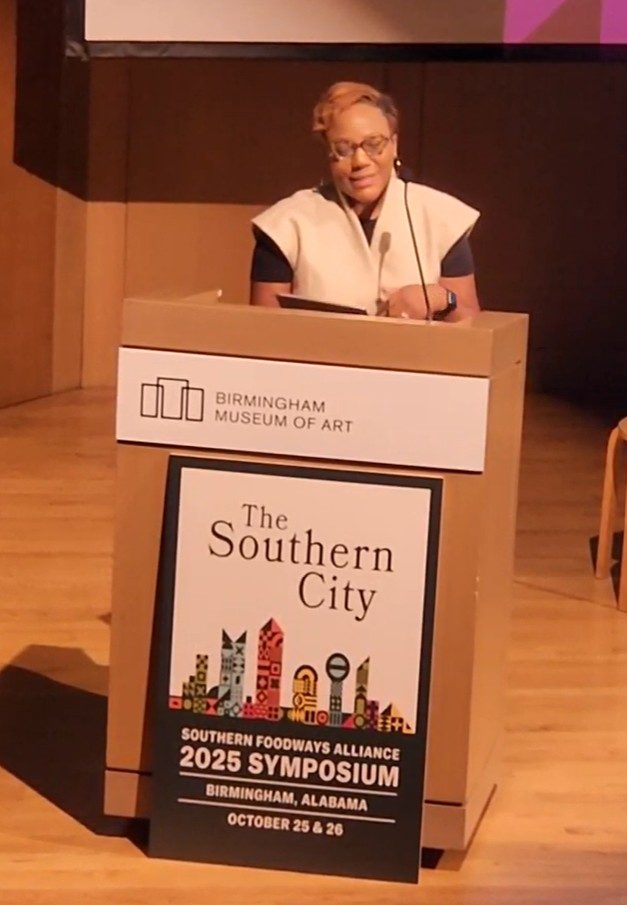
This fall has been a whirlwind at MDC—new partnerships, big ideas, and a lot of mileage. One stop surprised and delighted us in equal measure: the Southern Foodways Alliance (SFA) Symposium, hosted this year in Birmingham, Alabama.
Why Birmingham? That’s a story SFA tells best. Each year, the Symposium migrates across the South to lift up the history, art, policy, and practice of Southern foodways is not just what’s on the plate, but the cultural norms and culinary practices that shape how communities live, work, and belong. The moveable feast is also a moveable classroom.
Beyond the clink of forks
Yes, the food was excellent! But the substance went far deeper than menus and recipes. Conversations wrestled with questions our region must answer together:
- Housing & commercial rents. What happens to a city’s food culture when cooks and servers can’t afford to live near their jobs, and when beloved neighborhood restaurants are priced out?
- Immigration & local food systems. Policy decisions reverberate through farms, kitchens, and dining rooms, reshaping labor, supply chains, and the future of regional cuisines.
- Youth, education & food practices. Early experiences with food connect learning, health, and culture—schools and youth programs are pivotal.
- Succession for community-rooted businesses. Restaurants are anchors. We need apprenticeships, mentorship, and financing for new owners, especially from the communities these businesses serve.
These themes echo across MDC’s work: Thriving local economies are built on people, place, policy, and how we show up for each other.
Framing the Southern city
MDC had the honor of opening the 2025 SFA Symposium. Our president, LaKeisha Hood Moïse, offered a way to understand the Southern city within a region too often flattened as “mostly rural.” The truth is more complex: cities and rural places are interdependent. You cannot have a thriving city without thriving rural communities—because our food, raw materials, and a profound share of our culture originate there.
LaKeisha named the headwinds families face in Southern cities today:
- Affordable child care and early childhood education are not “extras”, they’re engines of economic mobility.
- Workforce & transportation gaps sever the path to skills and jobs.
- Housing affordability & displacement push long-time residents out and unravel the cultural fabric that makes a place “home.”
- Public health & food systems shape life’s outcomes: diet-related illness isn’t about willpower; it’s about access—to healthy food, to healthcare, to neighborhoods that aren’t food deserts or food swamps.
- Education challenges & out-migration drain rural communities and create uneven urban pressure. When either suffers, both lose.
The costs are economic AND cultural. When families are priced out, cut off, or left behind, we lose place and belonging.
A story from MDC’s hometown: Durham’s two truths
Our hometown offers a vivid example. A bustling downtown with a celebrated food scene sits alongside neighborhoods where poverty rates have hardly budged in a decade. That’s why MDC helped launch Made in Durham, a career-pathway initiative making sure young people can connect to the region’s new economy — not as spectators, but as skilled contributors with options.
This is the heart of our message: the Southern city should deliver options, choices, and access. That work must start early, because early and consistent investments change the trajectory of a child and the whole family.
Lessons we’re carrying forward
From Birmingham, we’re carrying forward a few truths that guide MDC’s work across the South:
- Equity is an economic strategy—not charity. Regions don’t thrive on press releases and statements; they thrive when more people can participate and prosper.
- Invest early and stay consistent. Returns on health, learning, and earnings compound across a lifetime and a community. This is not programmatic nicety; it’s an economic imperative.
- Place matters. Solutions must be rooted in community voice and designed with, not for, the people closest to the challenge. When community voice guides decisions from defining the problem to owning the results, efforts gain legitimacy, and staying power.
- Narrative is a superpower. Narrative sets the boundaries of what we imagine and the policies we pursue. Whoever tells the story of the South determines who is seen, who belongs, and whose future gets resourced. Elevating local voices reveals both our complexity and our possibility.
Foodways as a blueprint for how we live together
Foodways aren’t just about what we eat; they’re about how we coexist. Think of barbecue: every pit, every sauce, every smoke ring carries a lineage. We disagree, sometimes passionately, about which place does it best, but still gather at the same table. That’s the South at its best: diverse, complicated, honest about our pain points, and relentlessly inventive.
If we can honor that complexity around the table, we can honor it in our policy on housing, childcare, transportation, workforce, and health. That’s the work MDC shows up for, day after day.
Who we connected with—and what’s next
Symposiums like SFA’s knit together chefs, farmers, scholars, students, community leaders, and policy thinkers. We left Birmingham with new relationships, fresh urgency, and deeper resolve to build equitable systems that let Southern families write their own stories of meaning, dignity, and community.
We’re grateful to the Southern Foodways Alliance for creating a space where culture, policy, and practice share the same table. And we’re excited to keep partnering with people across the region who are cooking up change—one program, one policy, and yes, one plate at a time.
Want to stay in the loop on MDC’s work at the intersection of foodways, equity, and economic mobility? Follow our State of the South platform and sign up for the MDC newsletter.


